:max_bytes(150000):strip_icc():format(jpeg)/Sweetest-Holiday-Traditions-Around-the-World-FT-DGTL1225-Mince-Pie-01-18db5e2ef3c64f678033649076bf1289.jpg)
As beloved holiday food customs go, none are so sweet — literally — as the dessert traditions observed around the world. Many of the sweetest global traditions have a measure of ritual, whimsy, or indulgence: festive markets for marveling at intricately decorated cookies or gingerbread structures, decadent, fruited breads that straddle the line between breakfast and cake, or fanciful, showstopper desserts that are rightfully employed as holiday table centerpieces.
Whether you’re actually traveling this holiday season, or merely looking to indulge in a little sweet, culinary escapism, we rounded up seven of the can’t-miss holiday sweets traditions from around the world.
Bûche de Noël
Haris Calkic / Getty Images
France’s iconic bûche de Noël or “Christmas log” began as an actual log, a medieval, pagan tradition that evolved into a centerpiece dessert. Consisting of a rolled, filled cake outfitted as a rustic log with woodsy adornments — ersatz versions of holly berries, pine sprigs, and mushroom caps, all with a dusting of powdered sugar snow — variations on bûche de noël can be found throughout France’s boulangeries and patisseries during the holiday season. In Antibes, France, the log is nearly a whole tree, where a collective of local bakers conspires each year to create the world’s largest bûche de Noël during a mid-December event known as La Fête de la Bûche.
Gingerbread
eva kolenko / Food Styling by Natalie Drobny / Prop Styling by Genesis Vallejo / Gingerbread Styling by Amy Hatwig
Spicy and sweet, naughty and nice gingerbread has its early roots in ancient Greece, but it was Grimm’s tale of Hansel and Gretel in early 1800s Germany that inspired its use as a construction medium. Now, gingerbread is popular worldwide in its various forms during holiday markets and celebrations, and local gingerbread house competitions abound. For some of the largest displays of gingerbread architecture, however, look to The Gingerbread City displays and workshops in New York and London, or Bergen, Norway’s annual Gingerbread Village.
Mince pie
mtreasure / Getty Images
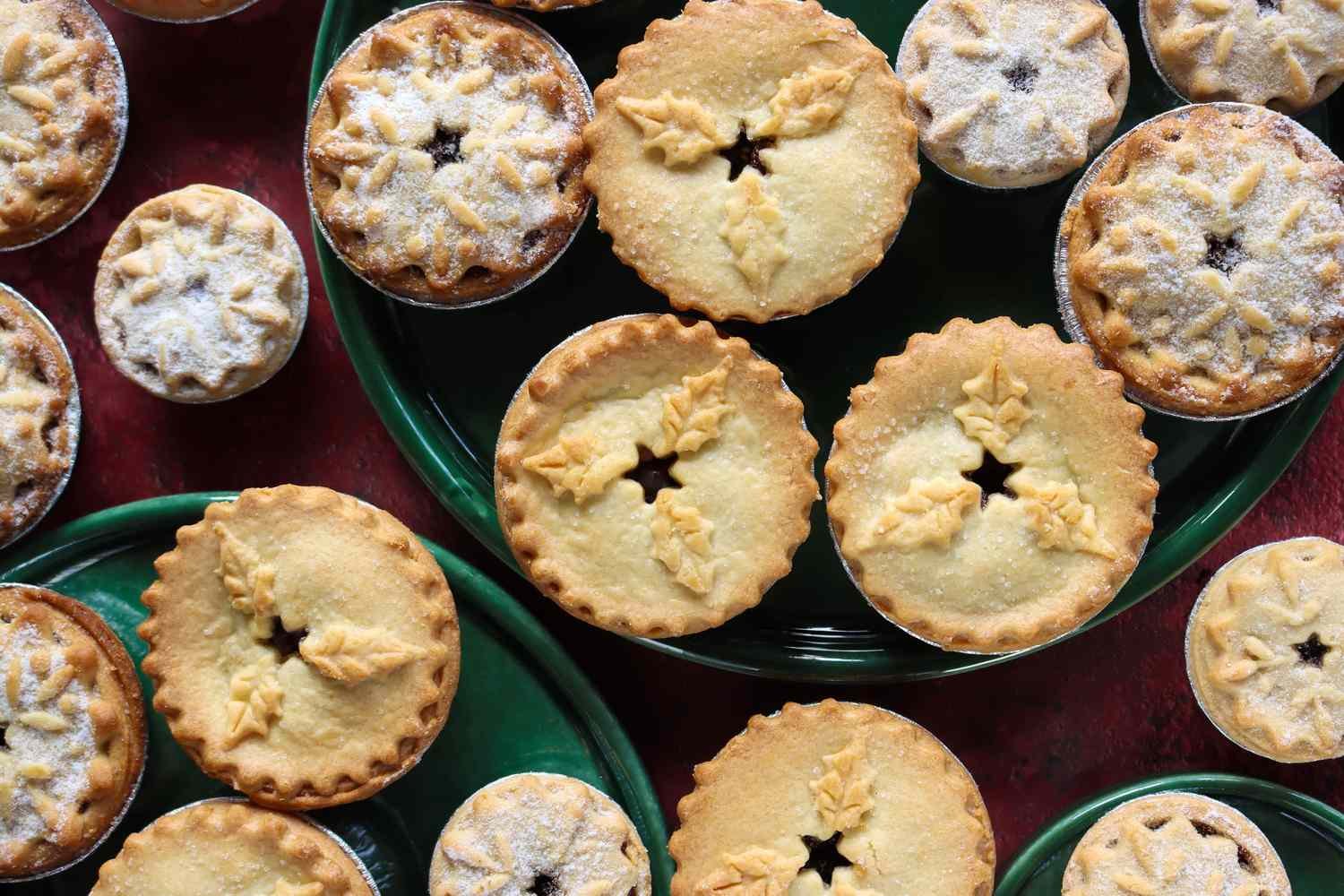
Much like pumpkin spice season in the United States, the unofficial herald of the holiday season in the United Kingdom is the arrival — seemingly earlier and earlier each year — of mince pies on grocery store shelves and in local bakeries. Miniature pies are filled with a “mince” of dried and fresh fruit, sugar, and suet, which is heavily spiced and often steeped in spirits, then topped with a decorative crust usually consisting of a star or lattice. London alone has over a dozen Christmas markets, and local grocer Morrisons gave away free pies — branded The Best Signature Mince Pies — at the Old Spitalifieds Market in November ahead of their official, Dec. 1 release. In Perth, Scotland, the holiday season is also bookended with a mince pie, in an annual New Year’s tradition with a relatable sentiment: The Last Mince Pie Run.
Stollen
a-lesa / Getty Images
Rich, spiced, and fruited breads are a common theme during the holidays, from fluffy Italian panettone with its ubiquitous department store packaging, to dense and boozy English fruit cakes, to Mexico’s ring-shaped Rosca de Reyes. Among Germany’s famed Christmas markets, look for stollen, a rich, yeasted bread blanketed with powdered sugar and studded with candied fruits and marzipan. In Dresden, where stollen is revered with name-protected status as PGI Dresdener Christollen, the bread is celebrated in an annual Stollen Festival, taking place in early December.
Pavlova
jarafoti / Getty Images
Not all holiday sweets are necessarily rich and spiced in nature. In Australia and New Zealand, where Christmas coincides with summer holidays, the star of the holiday table is a pavlova, an airy meringue wreath topped with seasonal fruits and cream. While the origins of the pavlova are murky, with both countries claiming variations on its origin story, its popularity as a holiday dessert over more traditional, colonial options such as mince pies and plum puddings goes back about a century. Look for intricately decorated pavlovas in patisseries or gourmet shops when visiting, or DIY with pavlova bases readily available from local department stores such as Woolworths.
Kurisumasu Keki (Japanese Christmas Cake)
show999 / Getty Images
Taking cues from Western celebration cakes, Kurisumasu Keki, or “Japanese Christmas Cake,” became popular as a symbol of abundance and prosperity after the country’s rebuilding years following World War II. A light sponge cake filled with cream and decorated with strawberries — the model for either of the available “cake” emojis — Kurisumasu Keki is typically eaten on Christmas Eve and is the primary mode for observing the holiday, not as a religious celebration in Japan but as a cultural and commercial one. Look for the festive cakes in bakeries and convenience stores during the month of December; it is a popular item even at 7-Eleven.
Buñuelos
hayaship / Getty Images
Gingerbread and stollen may dominate the Christmas markets in Germany, but in Mexico City’s Zócalo Christmas Market, in the square adjacent to the county’s largest cathedral, buñelos are the holiday sweet of choice. Variations on buñelos are widespread throughout Central and South America during the holiday season: fried dough that may come either flattened or shaped into twists, which may incorporate indigenous yuca for a toothsome, starchy version, and which may be dusted with cinnamon and sugar, studded with anise seed, or served with piloncillo syrup.