:max_bytes(150000):strip_icc():format(jpeg)/The-Best-Way-to-Make-Whipped-Cream-FT-DGTL1125-Hero-e9d74edd74cf4995bafbacbffbefb64b.jpg)
- Use very cold heavy cream when whipping. Chilled equipment is optional, but cold cream is a must.
- The combination of a whisk and a bowl is the best method to whip a small amount of cream. For larger amounts, a stand mixer is easiest and cleanest.
- Powdered sugar is the best sweetener for whipped cream. It dissolves easily and helps to stabilize the whip.
Whipped cream is the final flourish or headlining ingredient of so many winning dessert recipes. Whether crowning a slice of pumpkin pie or anchoring a bowl of double-chocolate whip, it serves as the ultimate finishing element, tying together different flavors and textures with a light, airy finish.
As a food stylist, I’ve styled hundreds of recipes requiring the perfect dollop. Yet after years in the field I’ve seen countless formulas for whipping. Some chefs swear by whisking by hand for superior control, while others wouldn’t use anything but a stand mixer for ease. Recipes differ as well. Many call for powdered sugar to sweeten, while others simply use granulated. A myriad of methods promising faster, easier, or more stable results sparked my curiosity to understand what truly matters. I stocked my fridge with heavy cream, readied my collection of small kitchen appliances, and decided to get to the bottom of the matter.
A note about my method
To evaluate the best way to whip cream, I focused on three key factors: whipping mechanism, temperature, and sweetness.
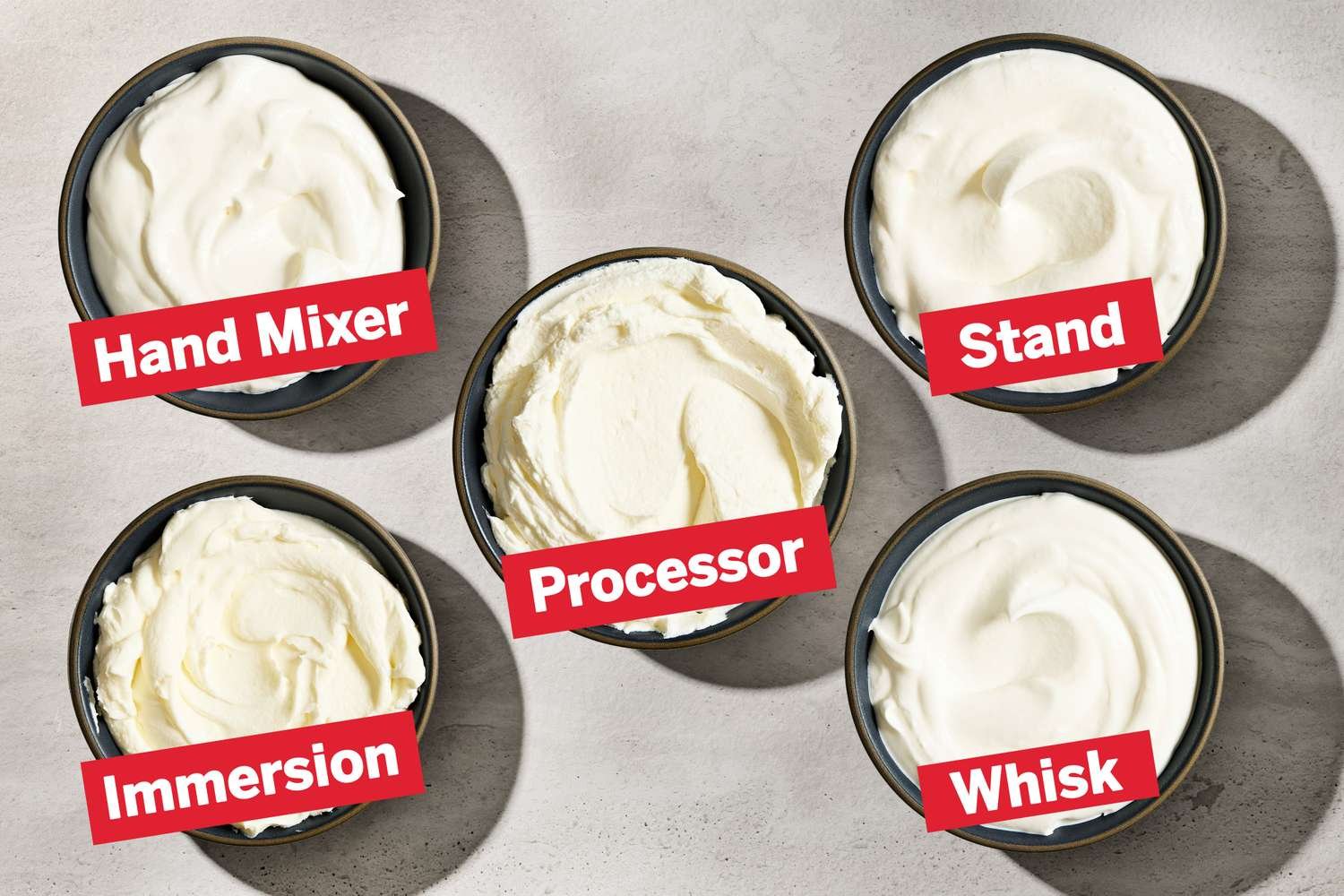
First, I considered the small appliances that most home cooks own. I tested common whipping tools, such as the hand mixer and stand mixer, and less-used options, including a food processor and immersion blender. For good measure, I compared results from each of these to the old-fashioned method of using a bowl, whisk, and forearm strength to whip cream by hand.
For each test, I whipped 1 cup of heavy cream to medium-stiff peaks (which curl slightly when the whisk is pulled from the cream). I carefully measured the time required and the final volume to evaluate both ease and end texture of the methods.
Second, I wondered if using cold versus room temperature equipment made a difference. I tested whipping by hand, with a stand mixer, and a hand mixer, using bowls and whisks chilled well in the freezer. I didn’t notice any major difference in texture, volume, or whipping time based on equipment temperature, so I excluded this factor from my final results.
Finally, I considered how to sweeten the cream to pair with less-sweet desserts. Many recipes call for powdered sugar, while others use granulated. I also tested simple syrup to see if it offered a superior method for adding sweetness. To incorporate the sweeteners, I whipped the cream on low speed just until thickened, then added the sweetener and continued whipping until I reached medium-stiff peaks.
Many bowls of fluffy cream later, I have results to share. Read on for my preferred methods.
Best overall method: stand mixer
Food & Wine / Erin Merhar
Active time: 1 minute 45 seconds
Yield: 2 cups + 3 tablespoons
Method: I placed 1 cup of very cold heavy cream into the 5-quart bowl of a KitchenAid Artisan stand mixer. Using the whisk attachment, I started mixing on low speed, gradually working my way up to medium speed, until the cream started to thicken, about 45 seconds. I continued to beat the cream, gradually increasing from medium to medium-high (speed 8), until the cream reached medium-stiff peaks, about 1 more minute.
Results: The cream whipped up smooth and fluffy. It yielded the airy yet rich consistency that I strive for when whipping a bowl of cream. It was one of my favorite methods for texture and required the least amount of effort.
Pros: Using a stand mixer is the easiest way to whip larger batches of cream (at least 1 cup in volume). It’s largely hands-off and one of the cleanest methods, with splatters from the whisk staying inside the tall bowl.
Cons: Not everyone owns a stand mixer, and if you do, it can be a pain to lug it to the countertop for such a simple task. Whipping less than 1 cup is a challenge. The whisk attachment may not be able to reach the small volume at the bottom of the bowl to properly incorporate air.
Best method for a small batch: whisking by hand
Food & Wine / Erin Merhar
Active time: 2 minutes and 15 seconds
Yield: 2 1/4 cups
Method: I poured 1 cup of very cold heavy cream into a large mixing bowl. I used a large balloon whisk to whisk the cream until slightly thickened, about 1 minute. I then tilted the bowl slightly while whisking vigorously in a back and forth motion until the cream reached medium-stiff peaks, about 1 minute to 1 minute and 30 seconds more.
Results: The end consistency was aerated, pillowy, and very smooth. Its texture was nearly identical to the batch made in the stand mixer, though it did take slightly longer. The end result, however, was just as pleasing.
Pros: This is the easiest way to whip cream as it doesn’t require any special tool or electronic device. I had the most control over the end result because I could change the intensity of how hard I was whisking. Maybe it’s just me, but I felt more attuned to this batch, perhaps due to my physical efforts, and was able to finish the cream at an ideal texture.
Cons: Wow, did my forearm muscles burn after this test! I can’t imagine whipping a higher volume than 1 cup (which would undoubtedly take longer). The physical strain was pretty much the only negative that I observed.
Easiest method with minimal equipment: hand mixer
Food & Wine / Erin Merhar
Active time: 3 minutes
Yield: 2 cups + 2 tablespoons
Method: I placed 1 cup of very cold heavy cream into a large mixing bowl. I used a hand mixer with two whisk-style beaters attached. I started at speed 4 and worked my way up to speed 6. It took about 3 minutes to reach medium-stiff peaks.
Results: The end result was very similar to the light, creamy texture that the stand mixer or whisking by hand yielded. It took a bit longer than both of those methods, which I attributed to the smaller size of the beater.
Pros: The consistency was smooth and rich yet light and airy. It was far easier to ready my hand mixer than set up a stand mixer. This method also required far less effort (and invoked far less pain!) than whipping by hand.
Cons: Post-whip…my kitchen was a mess! The way with which the cream moved through the beaters splattered little droplets all over my kitchen countertop. Since I have white walls, I truly have no idea how far the splatters flew, but this method required by far the most cleaning that I had to do of any of the tests. Other than the slightly longer whipping time, this was the only negative point I observed for this method.
Best method for a rich, sturdy whip: food processor
Food & Wine / Erin Merhar
Active time: 1 minute, plus 5 additional pulses
Yield: 1 2/3 cups
Method: This method was new to me, but I was curious to give it a try. I added 1 cup of very cold heavy cream to the large bowl of a food processor. I processed for 30 seconds then stopped to scrape down the sides of the bowl. I processed for another 30 seconds then scraped down the bowl and tested the texture. As the cream had nearly reached medium-stiff peaks, I pulsed the processor just 5 more times to finish.
Results: The end volume of this cream was far less than other tests due to the limited air that the food processor incorporates. The cream was dense and heavy, more akin to the consistency of crème fraîche or clotted cream. Its texture wasn’t great for dolloping, but would work very well spread on top of a trifle or a decorative dish of chocolate mousse.
Pros: No splatters! The sealed lid of the food processor meant that the cream and splatters stayed in the bowl. The end result was denser, which also made it more stable. This could be a good make-ahead method if you need to whip cream further than a couple of hours in advance of serving.
Cons: With the cream enclosed in the food processor bowl, it was difficult to see its texture and therefore gauge when it reached medium-stiff peaks. I had to stop and start a couple of times to scrape sides and test its consistency. Due to the lack of visibility, you run the risk of over-whipping.
If you must: use an immersion blender
Food & Wine / Erin Merhar
Active time: 3 minutes
Yield: 1 1/2 cups
Method: I had the most questions about using this apparatus, but an immersion blender creates beautiful texture when making homemade mayonnaise, so I thought it was worth a try. To test, I poured 1 cup of very cold cream into a quart-size deli container. I placed the shaft of the blender into the cream with the bottom of the wand touching the bottom of the container. While mixing on medium speed, I lifted the blender up and down, tilting the container as needed to ensure the blade was reaching all parts of the cream.
Results: This took the same amount of time as the other longest method, whipping with a hand mixer, and yielded the smallest amount, as the tiny blades in the immersion blender incorporated the least amount of air into the cream. The texture was dense and heavy, similar to the results from the food processor.
Pros: It’s nice to know that you can use an immersion blender to whip cream if you don’t have a whisk or find yourself with no other option. (Though you could also shake cream in a jar!)
Cons: The cream whipped, but unevenly, as it was hard to get the blade to reach the cream in the corners of the container. Because it was whipping different parts of the cream to different textures, I needed to stop and scrape the blades a couple of times, then fold the cream together to see the consistency.
What is the best way to sweeten whipped cream?
After finding my favorite ways to whip cream, I shifted my attention to sweeteners. As outlined in my method, I tested powdered sugar, granulated sugar, and simple syrup, consistently adding 2 tablespoons of each to 1 cup of heavy cream.
Powdered sugar ranked as my preferred sweetener for whipped cream. It dissolved most easily, yielding the smoothest texture. As an added bonus, the cornstarch or tapioca starch commonly added to powdered sugar helped to produce a sturdier whip. I did find that 2 tablespoons of powdered sugar only sweetened the 1 cup of cream slightly. I tested again with 4 tablespoons, and this felt properly sweetened. Salt added an interesting element to both tests. A tiny pinch added to the lightly sweetened cream tasted too salty, whereas 1/8 teaspoon added to the cream whipped with more sugar balanced all of the flavors.
Granulated sugar also worked well to sweeten, but took longer to dissolve. Two tablespoons of granulated sugar adequately sweetened the cream, but I recommend adding it to the cream right from the start so that it has more time and agitation to liquify. This wasn’t my favorite method, but if you only have granulated sugar in your pantry you should definitely use it.
Simple syrup was an easy addition, given that the sugar was already in liquid form. I added 2 tablespoons from the start, which was enough to properly sweeten 1 cup. It also sparked an idea: An infused simple syrup could be a vehicle to impart other flavors into whipped cream, such as citrus and herbs. However, since simple syrup isn’t typically a pantry staple, it was my least preferred of the three methods. Of course, if you only have granulated sugar, you could easily make your own simple syrup first — just be sure it’s cooled completely before adding it to the cream.
How do you fix whipped cream that is over-whipped?
It happens to the best of us. If you accidentally overwhip your cream and it’s starting to look slightly separated or curdled, fear not — it can be saved! Add 1 to 2 tablespoons of cold heavy cream to the bowl and use a rubber or silicone spatula to very gently fold it into the cream until it comes back to a nice, creamy consistency. You’ll know you’ve saved it when you can once again create a soft dollop.
Final takeaways
The good news is that you have plenty of great options for whipping and sweetening cream, depending on your tools and ingredients.
My top recommendation is to use a stand mixer with powdered sugar when whipping more than 1 cup of cream. For a smaller amount, flex your muscles and do it by hand to maintain the best control and consistency. Now go forth and create the perfect dollop!