:max_bytes(150000):strip_icc():format(jpeg)/Transparent-Pie-Explainer-FT-DGTL1125-03-7fe121ba15d84af6a70d28516bb18428.jpg)
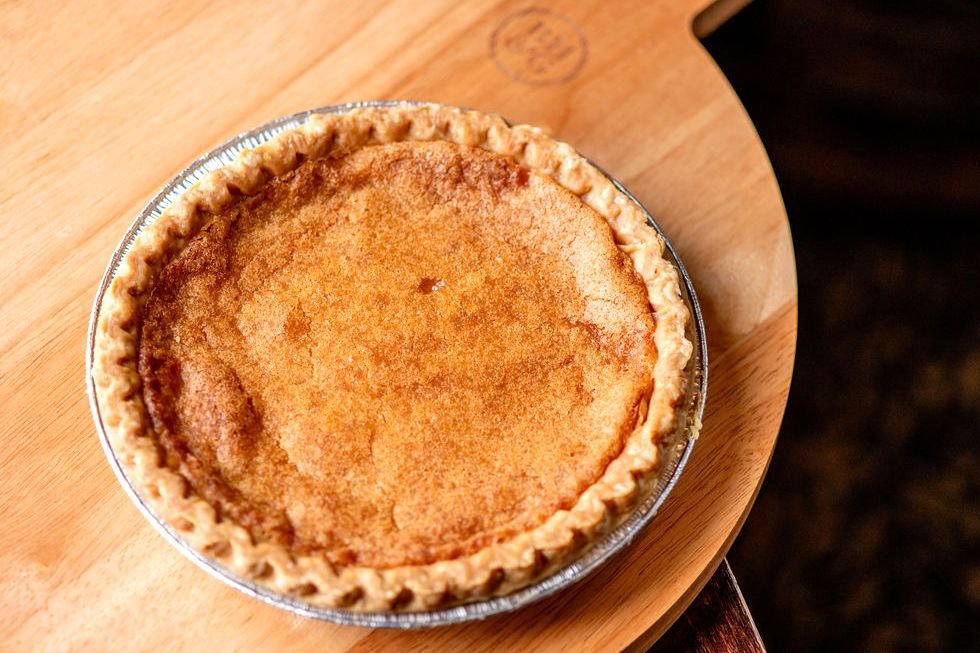
Transparent pie doesn’t look like a dessert that should inspire devotion. It’s pale, modest, and smooth on top — no meringue spirals, no fruit glisten, no dramatic lattice. Yet in and around Maysville, Kentucky, transparent pie is inseparable from holiday tables, family lore, and local pride. It’s the treat people bring home from road trips, the one grandparents insist on at Thanksgiving, and the one bakery regulars buy by the stack “just in case.” (Maysville native George Clooney has even been said to share slices on movie sets.)
At a glance, transparent pie seems simple. But like with so many regional specialties, its apparent simplicity belies a rich backstory.
What makes it transparent?
Sheri Castle, cookbook author and Emmy-winning host of PBS’s The Key Ingredient, places transparent pie “in the very broad category of chess pie or custard pie.” She explains that it behaves like a chess pie but differs in a couple of critical ways: flour thickens the filling instead of cornmeal, and it doesn’t include an acidic element like lemon juice or buttermilk.
Castle says the name “transparent” has nothing to do with clarity. Historically, the term described pale-colored foods, like heirloom transparent apples. Transparent pie is “a pale, creamy color,” she notes, without any chunky additions like nuts or fruit. Castle calls it “a very honest pie,” with no hidden ingredients or tricks — just butter, sugar, eggs, cream, and the right touch.
Transparent pie’s appeal isn’t decorative; it’s sensory. Castle says people go back for bite after bite not because it’s complex, but because it’s pleasurable, particularly the texture. Getting it right requires instinct more than style. Overbaking turns the custard grainy; baking it just right produces a thin, silky slice that trembles on the fork. “There’s only one thing going on,” Castle adds, comparing it to a bowl of well-made pasta. “You better nail it well.”
Food & Wine / Photo by Kelsey Hansen / Food Styling by Lauren McAnelly / Prop Styling by Gabe Greco
A pantry pie with farm roots
Like most beloved Southern desserts, transparent pie began as an act of resourcefulness. Castle describes it as a “pantry” or “farmstead” pie — something a cook could make without leaving the house. Butter and cream came from the dairy cow, eggs from the henhouse, flour and sugar from the pantry. It did not require specialization or equipment.
“It will come together with things that people have on hand,” Castle says, describing a pie that feels intentionally unadorned. Even today, many versions avoid vanilla, harking back to a time before an imported ingredient became the flavor of “plain” American desserts; some transparent pies rely entirely on the flavor of eggs, cream, and butter.
Castle doesn’t consider transparent pie a holiday showstopper. In her eyes, it’s a “workaday” pie — what you make on a Tuesday, not when the cousins are flying in. But that practicality may be why the pie matters so much now. Transparent pie has migrated from everyday life into nostalgia. It tastes like a remembered kitchen.
The pie with staying power
Transparent pie’s association with Maysville is so strong that outsiders assume it was born there. But historian Dr. James B. Seaver of the Kentucky Historical Society discovered something surprising: Transparent pie existed long before Maysville claimed it.
While researching old newspapers and cookbooks, Seaver found references to “transparent pudding” as early as the 1760s in England. By the 1820s, recipes appeared in New England and the Carolinas. The earliest transparent pies were made before the Civil War and appeared at county fair baking competitions throughout the Ohio River Valley. Transparent pie wasn’t invented in Kentucky.
But Kentucky did something just as powerful as creating transparent pie: The state held on to it.
Seaver believes transparent pie became a Maysville signature because local bakeries — most famously Magee’s Bakery — staked their identity on it. Over time, residents developed loyalty not just to the pie itself, but to their version of it. “The interesting thing isn’t where it originated,” Seaver says, “but where it stayed.”
Courtesy of Magee’s Bakery & deSha’s
The bakery that kept it alive
Magee’s Bakery sold transparent pie for nearly a century. When the bakery closed in 2023, deSha’s restaurant took on the responsibility of preserving the recipe, working directly with the last owner to ensure fidelity. Cindy Gilkison, the current baker at deSha’s, says the restaurant still uses the original recipe from the 1930s: butter, sugar, eggs, cream, a pinch of flour, and a “secret little Magee’s touch.”
First-time customers often hesitate when they see it on the menu. What is it, exactly? But Gilkison says that with a little encouragement, they take a first bite…and immediately order more. During the holidays, the team bakes hundreds of “transparent puddin’s,” individual-sized pies sold by the box. Locals request them for birthdays, anniversaries, even weddings.
Transparent pie may have once been an everyday pie, but in Maysville, it’s now ceremonial. For families in Northern Kentucky, Thanksgiving is not Thanksgiving without transparent pie.