:max_bytes(150000):strip_icc():format(jpeg)/American-Waygu-Leveling-Up-FT-DGTL1225-Vermont-Waygu-NyStripChuck-b70dba71f8ca40caa4e7407b967455a7.jpg)
- American Wagyu offers much of the richness people associate with Japanese Wagyu, often without the extreme cost.
- The American Wagyu market is increasingly well regulated. The new USDA “Authentic Wagyu” label certifies that beef is full-blood Wagyu raised in the U.S.
- Chefs are embracing American Wagyu for flavor, flexibility, and transparency.
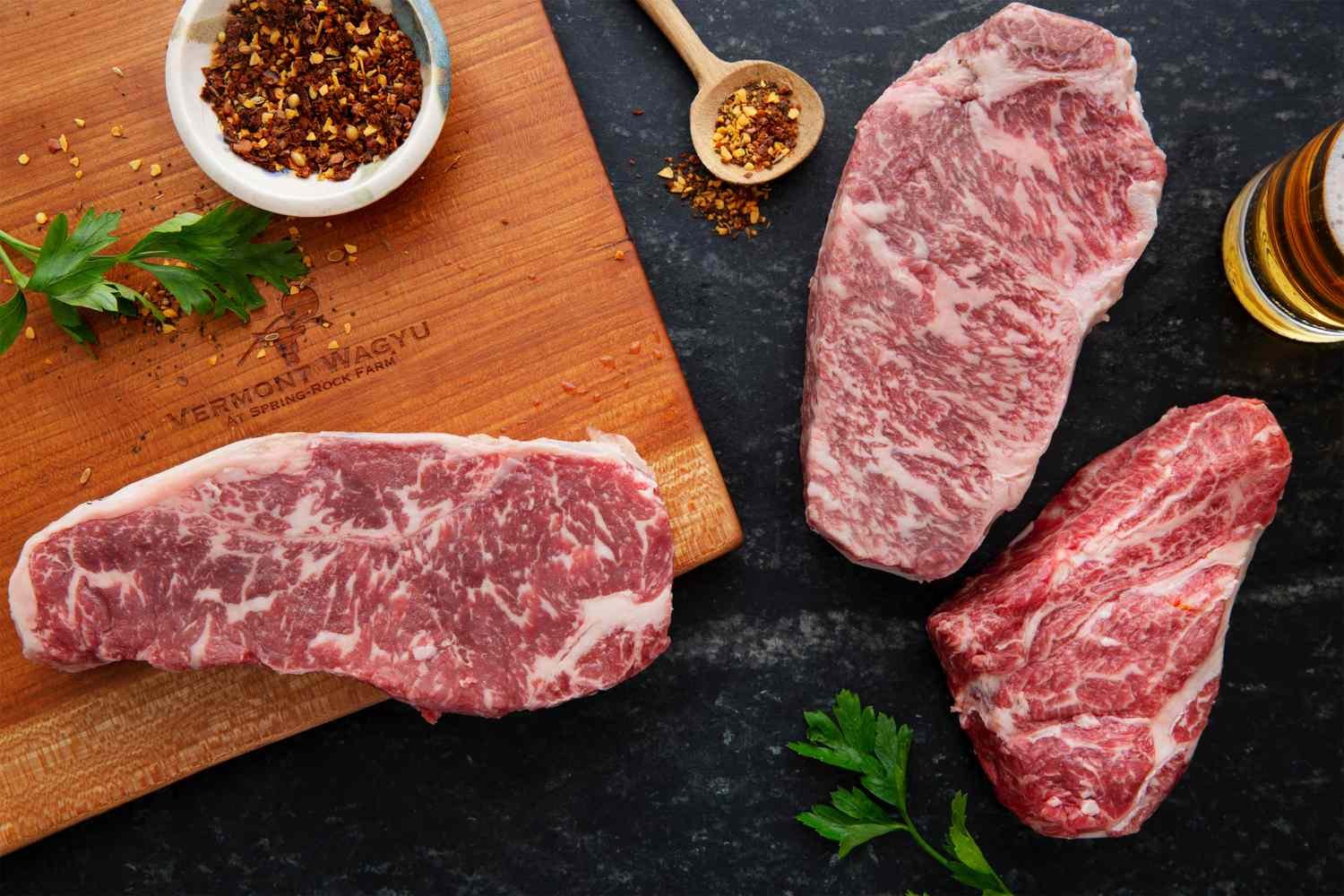
Vermont Wagyu founder Sheila Patinkin wants you to know that her heavily marbled beef is genuine Wagyu — unlike much of what was infamously mislabeled Wagyu in the early 2010s — and she can prove it. As former president of the American Wagyu Association, Patinkin helped develop the U.S. Department of Agriculture’s Certified Authentic Wagyu program, which went into effect in January 2025.
That year, Vermont Wagyu became the first farm in the U.S. to print the official verification on its products: The “Authentic Wagyu” label assures customers that its beef is full-blood Wagyu — meaning that 100% of its cattle’s DNA has been traced to the Japanese breeds that define the Wagyu category.
Courtesy of Vermont Wagyu
Since adding the verification label, the direct-to-consumer company has seen a 22% increase in online sales, Patinkin says. It’s a spike in demand that tracks with global trends. Global Wagyu beef sales are expected to rise from $25.34 billion in 2024 to $42.69 billion by 2032 — an increase of 68% — according to Fortune Business Insights. Sales are led by full-blood cattle like Vermont Wagyu’s, which haven’t been crossbred with non-Japanese breeds. These require greater up-front costs and time — for example, close to 900 days before reaching market size, rather than around 600 days for typical Angus beef — and command premium prices.
Because most full-blood American Wagyu producers are vertically integrated (meaning they raise and sell their own beef without needing to share detailed records with a governing agency, rather than sending it to the commodity beef market to be graded and reported by the USDA), “nobody really knows the size of the full-blood Wagyu market in this country,” Patinkin says. Some estimates put it below 1% of the total U.S. cattle population.
What makes full-blood American Wagyu different?
“Full-blood cows mature slower, producing a much higher percentage of intramuscular fat with a much higher quantity of monounsaturated fatty acids, including oleic acids similar to those found in extra-virgin olive oil,” says Nathan Lockwood, executive chef-owner of Seattle restaurants Altura and Carrello.
For his restaurants, Lockwood breaks down whole full-blood American Wagyu cows that have been pasture-raised just 14 miles away by Magnolia Cattle Company. Each animal matures for far longer than typical — “the best cow we have received from them was eight years old,” he says. “Guests regularly tell us how distinct and complex our beef tastes.”
This higher quality is also reflected in the new American Wagyu certification, which indicates not only traceability but also Prime level two, or Prime+. The higher level reflects greater fat marbling in the beef, and “the more the marbling, the better the palatability; that’s pretty well scientifically proven,” says Patinkin.
High levels of intramuscular fat give Wagyu its intense umami and unctuousness. And in the past five years, technological advances have allowed Vermont Wagyu to increase its cattle’s intramuscular fat by five times, exceeding the average marbling of the U.S. herd by a factor of seven, Patinkin says. “We are catching up to the Japanese herd quickly with genetic improvement in the full-blood herd.”
Understanding Wagyu terms
- Wagyu: The word translates literally as “Japanese cow” and applies to four Japanese breeds known for their richly marbled intramuscular fat: Kuroge Washu (Japanese Black), Akage Washu or Akaushi (Japanese Brown), Nihon Tankaku Washu (Japanese Shorthorn), and Mukaku Washu (Japanese Polled).
- Full-blood: Cattle that haven’t been crossbred with non-Wagyu breeds and are therefore 100% Wagyu
- Purebred: Cattle that have been crossed with non-Wagyu breeds but have at least 93.75% Wagyu DNA
- Crossbred: Wagyu that have been crossed with other breeds like Angus and contain less than 93.75% Wagyu genetics. F1 Cross is a common 50/50 cross of Wagyu with another breed
- A5: The highest yield (A on a scale of A to C) and quality (5 on a scale of 1 to 5) in the Japanese beef grading system
Why restaurants are choosing American Wagyu
Most American Wagyu is a crossbreed between Japan’s endemic Wagyu breeds and Angus, sitting somewhere between the luxury of full-blood Wagyu (which costs at least $50 per pound for most Vermont Wagyu cuts or double that if imported from Japan) and the affordability of America’s primary commodity breed (around $10 a pound in July 2025, amid surging prices).
Crossbred American Wagyu may not have the consistently extreme marbling of full-blood, but it’s “the best of everything when it comes to beef — it’s a melding of the ultra-rich, marbled Japanese A5 [the highest grade of Japanese Wagyu] that we have become accustomed to and the intense beefy flavor of the domestic Black Angus,” says Brandon Muehl, culinary director of Ascend Prime Steak & Sushi in Bellevue, Washington.
anuel Echeverri, concept chef and partner of Bazaar Meat by José Andrés
“When we started, Wagyu was almost a secret indulgence; now it’s a full category.”
— anuel Echeverri, concept chef and partner of Bazaar Meat by José Andrés
Muehl says it’s gotten easier and more consistent to source American Wagyu, which he buys from two of the oldest producers in the country — Snake River Farms in Idaho and Mishima Farms in Washington — and awareness of domestic Wagyu is rising. “Guests are increasingly familiar with Wagyu, but many don’t realize that there are different categories.”
To help consumers better understand the differences between various types of Wagyu, Ascend serves tasting flights of American, Australian, and Japanese Wagyu, giving diners “the opportunity to taste across the spectrum without being intimidated.”
Courtesy of Vermont Wagyu
“American Wagyu also makes sense on price and logistics versus imported A5, while still being a premium, traceable product from domestic producers,” says Manuel Echeverri, concept chef and partner of Bazaar Meat by José Andrés, which just opened its third location at The Ritz-Carlton New York, NoMad. “When we started, Wagyu was almost a secret indulgence; now it’s a full category and a big driver of why guests visit Bazaar Meat in the first place.”
Most of Echeverri’s guests come in already knowing to ask if the Wagyu is Japanese or American. “Where we still do a lot of education is around what that means in terms of richness, portion size, and texture,” he says — whether it’s an uncertified full-blood Akaushi rib eye from HeartBrand Beef in Flatonia, Texas, or a crossbred rib eye from Rosewood Ranches in Dallas. That education will be more important than ever as full-blood American Wagyu closes the gap between expectations of American and Japanese Wagyu.
Kenichiro Yamasaki, one of Japan’s few certified Wagyu masters, believes it would benefit both American and Japanese producers if the U.S. developed a “Wagyu academy” to train professionals on the cultural, technical, and agricultural context of Wagyu. (A consulting and importing business just certified its first class of Wagyu sommeliers in September in partnership with the Institute of Culinary Education’s Los Angeles campus and the Embassy of Japan, but focused on Japanese Wagyu rather than Wagyu in general.)
American Wagyu’s global reach
The executive chef of New York City’s Togyushi, the first restaurant in the U.S. to serve Japan’s rare Zao Wagyu, Yamasaki points out that crossbred American Wagyu is already widely used in Japan, “especially in cost-driven dining segments such as rice-bowl chains, fast-food concepts, casual steakhouses, and budget yakiniku restaurants,” since its affordability and leaner profile lend themselves to larger portions. He sees this as supporting rather than diluting the appeal of full-blood Japanese Wagyu.
“A useful comparison is the worldwide rise of sushi. Although sushi originated in Japan, its global expansion was largely driven by American creativity such as the invention of the California roll,” Yamasaki says. “These innovations did not diminish traditional sushi; instead, they helped it grow into a global culinary category.”
Yamasaki thinks Wagyu may be on a similar trajectory. “With proper education, clearer communication of differences, and cross-cultural collaboration, Wagyu has the potential to become an internationally recognized category, one that encompasses diverse production styles while preserving the identity of Japanese Wagyu.”