:max_bytes(150000):strip_icc():format(jpeg)/Chicago-vs-New-York-Cheesecake-FT-DGTL1225-84e6c8de2b4a49b3a543728013fcd934.jpg)
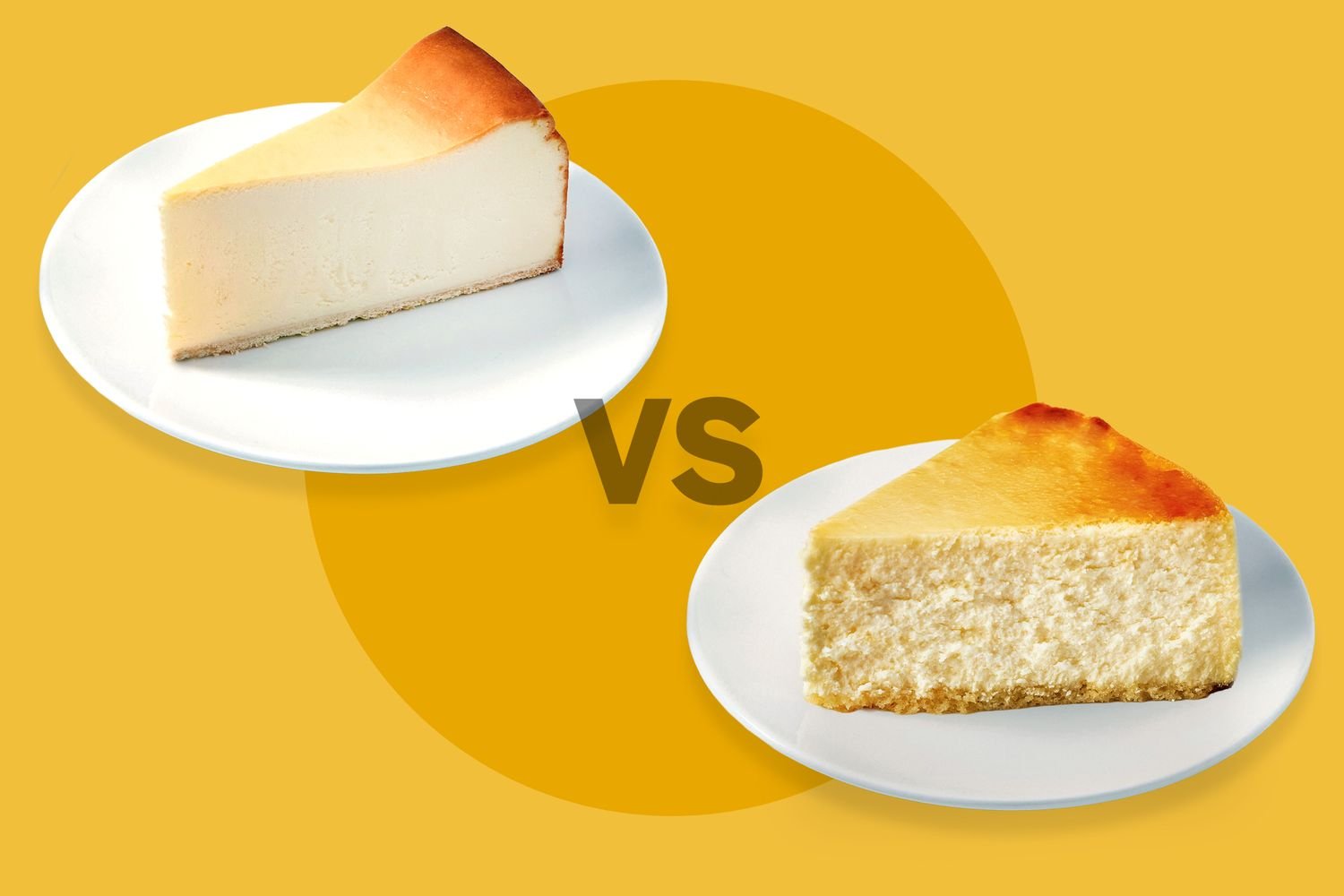
- New York and Chicago have unique styles of cheesecake that developed decades apart.
- New York–style cheesecake’s typical pale exterior and ultra-dense texture come from a low and slow bake with a water bath.
- Chicago-style cheesecake is similar to Basque-style, baking high and dry for more caramelization outside and creaminess inside.
Cheesecake may have originated in ancient Greece, but it has spread far and wide, evolving to encompass airy German käsekuchen, crumbly Corsican fiadone, and soufflé-like Japanese cheesecake, among many other styles. The United States is home to several unique versions of the dessert, including from two cities whose food rivalries are legendary: New York and Chicago. For the uninitiated, here’s a slice of regional cheesecake history.
What is New York cheesecake?
New York cheesecake is generally credited to New York City restaurateur Arnold Reuben (better known for his namesake sandwich), though it quickly became a ubiquitous part of the food scene in the city and beyond.
“Cheesecake has been part of New York’s deli culture since the 1930s, when Jewish dairy restaurants and delis first started serving rich, baked cheesecakes made with cream cheese,” says Sarri Harper, CEO and third-generation owner of NYC institution Carnegie Deli, which has one remaining physical location inside Madison Square Garden and ships items like cheesecakes and pastrami sandwich kits. “New York cheesecake is all about abundance. More cream cheese, more eggs, more everything. It’s rich, velvety, and substantial.”
Courtesy of Junior’s Restaurants and Bakery
In addition to heavy (not whipped) cream cheese, plain New York cheesecake features eggs, heavy cream, sugar, and vanilla. It typically sits atop a graham cracker crust, as seen at Eileen’s Special Cheesecake, a Food & Wine favorite in SoHo. It bakes low and slow in a water bath to avoid cracking and achieve a texture so dense you can barely cut through it without warming your knife first. Like any good tradition, though, this one has more exceptions than rules. Carnegie Deli, for example, includes sour cream, for a bit of balancing acidity, and a cookie dough crust that is “buttery, soft-baked, and just sweet enough to support the rich filling,” Harper says. Veniero’s, an East Village classic that opened in 1894, skips the crust altogether.
Another NYC icon synonymous with the style, Junior’s, rests its filling on a sponge cake. “It’s somewhat neutral and slides down easily with a cup of coffee, whereas if you put graham on the bottom, it sort of permeates the flavor of the cake, and it’s obviously more gritty,” says third-generation owner Alan Rosen. His grandfather, Harry Rosen, and Junior’s original baker, Eigel Peterson, landed on their enduring recipe after tasting their way through the competition in 1950, mostly places that no longer exist like Lindy’s and Jack Dempsey’s. With locations in NYC and at Foxwoods Resort Casino in Connecticut as well as nationwide shipping, Junior’s now goes through 4.5 million pounds of cream cheese a year, serving hefty slices that weigh nearly a pound, according to Rosen.
What is Chicago cheesecake?
Chicago cheesecake is a relatively recent invention. “In the late ’70s, Eli Schulman decided that cheesecake would be the signature dessert for his famous restaurant, Eli’s The Place for Steak,” says Maureen Schulman, daughter-in-law of Eli, co-author of The Eli’s Cheesecake Cookbook, and director of public relations for Eli’s Cheesecake, which began as a spin-off before becoming the core business.
Eli’s unique result was unveiled in 1980. “He broke all the rules of traditional cheesecake baking: a fast and hot bake with no water bath, and an all-butter shortbread cookie crust,” Schulman says. Slow-cultured cheese and sour cream lends complex tanginess; the high, dry bake creates “a golden brown caramelization on the outside and a firmer outer layer, while maintaining a rich, creamy interior texture.”
Photo by Neil John Burger
Schulman points out that the recipe is quite similar to a Basque cheesecake, simply baked for less time so it doesn’t have the burnt top that Santiago Rivera popularized about a decade later. Funny enough, she says, her father-in-law was just a little ahead of his time: “When Eli first started baking cheesecakes, he used to burn the tops.” Based on customer skepticism, he dialed back the cook time, and fluffy, browned-not-burnt Chicago-style cheesecake was born.
Eli’s bakes about 20,000 cheesecakes per day and has had plenty of famous fans, from Frank Sinatra to Barack Obama. But Chicago cheesecake’s close ties to its business of origin may explain why it’s not as widely known as New York cheesecake, which no one has a specific claim on anymore. “While pizza, hot dogs and Italian beef are Chicago favorites known around the country, they are usually referred to in a generic sense. When talking about cheesecake in Chicago, Eli’s is named specifically,” Schulman notes. Still, Chicago cheesecake has found its place as a Midwest favorite, and it influences some other makers, such as wholesaler Chicago Sweet Connection Bakery, which sells Chicago-style and New York–style cheesecakes.
What if I can’t choose between the two styles?
“I have a hybrid cheesecake,” says Stephanie Hart, owner of Chicago’s Brown Sugar Bakery. New York cheesecake can be “kind of thick on the tongue,” while Chicago cheesecake can be “a little too melty,” she says, so she landed somewhere in the middle with a cheesecake that is beautifully caramelized on the outside, soft and creamy inside. It crowns a crunchy butter cookie crust inspired by the butter cookies she remembers eating in Chicago Public Schools cafeterias. “It’s a simple recipe, nothing fancy.”