:max_bytes(150000):strip_icc():format(jpeg)/Tour-de-France-Holidays-FT-DGTL1225-hero-b624c8fa5d514832be43dff56216a1a5.jpg)
Nothing prepared me for my first Christmas in France. If an everyday lunch here is steeped in deep-rooted ritual — the courses! Cheese! Coffee and cookies!— the holiday réveillons are meals on steroids. There’s no holding back when it comes to the end-of-year fêtes. After midnight mass in the countryside, my family gathers around the table for an epic, all-night marathon of feasting.
Oysters from the Île d’Oléron are slurped with Champagne and segue into a seafood platter piled high with langoustines, clams, and crabs, followed by foie gras on gingerbread, then goose stuffed with chestnuts. There’s no skipping the cheese course — ripe and wonderfully smelly options might include an oozing Époisses and a local chèvre. The meal is capped by the bûche de Noël, the traditional yule log dessert that’s slathered in chocolate buttercream.
When it comes to the wine, family members bring out their best bottles. There’s a shared anticipatory glee to see what my brother-in-law hauls from his cellar in Toulouse, which he’s stocked from winemaker visits across the country. And before Père Noël can place presents in our shoes (arranged around the fire), there’s still a splash of poire, or homemade eau-de-vie, to be imbibed.
Needless to say, in a country where gastronomy is perceived as an art form, gifts take a backseat to the food. The table is the heart of the holidays (ditto on New Year’s Eve), and the spread that’s consumed during the réveillon represents a veritable Tour de France, both in the fine foods and the traditions cultivated in diverse geographical regions. Let’s embark on a gourmet odyssey around the table to taste them. A word to the wise: pace yourself!
Normandy, Brittany, and the Atlantic Coast
barmalini / Getty Images
The French coastal regions supply the holiday pièce de résistance: the oyster-laden seafood platter. I have a particular weakness for the Marennes Oléron oysters; there’s one type called La Pousse en Claire that’s a “red label” delicacy that represents only 1% of the local production. Though some would argue that these regions supply a different centerpiece: the butter! And indeed, my beau-père (father in law) is known to hold an oyster in one hand and a butter-slathered hunk of baguette in another.
Champagne
Alberto Gagliardi / Getty Images
What’s a party without Champagne? A bottle elevates any occasion, and French holiday celebrations are saturated with the good stuff. In Champagne country, it takes on special importance. Just ask Mathieu Roland-Billecart, CEO of Champagne Billecart-Salmon, the bubbly beloved by top sommeliers and a seventh-generation family affair.
“Christmas is very important in our family and it means two things: We go for prestige cuvées and in magnums as there are 12-15 people around the table!” he explains. “Our celebrations are typically held at my brother’s house and last a couple of days, so that gives us some choices …to have different cuvées over different meals. This year, we will start the celebration on Christmas Eve with magnums of Nicolas Francois 2007 and this will be followed with a couple of bottles of Clos Saint Hilaire 2009 over the meal… with a finish over dessert with our cuvée Elisabeth Salmon 2012 for a little more freshness. I find that the colder weather outside suits these Pinot Noir-based cuvées better, and the Clos Saint Hilaire also work beautifully with roast poultry. If you can’t find Clos Saint Hilaire, I am sure a magnum of Le Sous Bois would work just fine over the turkey.”
Dordogne and the Southwest
t sableaux / Getty Images
Leading up to Christmas, my local Monoprix stocks the shelves with foie gras, the “fatty liver” delicacy that’s de rigueur for a réveillon. My mother-in-law makes her own goose liver pâté; her free-roaming geese eat what they like (often table scraps). Typically a sliver of foie gras is served atop a slice of pain d’épices, or gingerbread (see more below). The producers in the Dordogne Valley, just east of Bordeaux, are particularly renowned, responsible for 90% of the country’s foie gras production. (Goose fat is also important in the traditional cooking of southwest France.)
Burgundy
frederique wacquier / Getty Images
Bourgogne may be synonymous with fine wine, but its Christmas contribution is pain d’épices. Made with rye flour, honey, and spices like cloves and nutmeg, this is not your typical gingerbread, but more akin to a spice bread. According to legend, Margaret of Flanders brought it with her to Dijon when she married Philip the Bold in the 14th century. The traditional recipe is safeguarded by bakeries like Mulot & Petitjean, founded in 1796 and now recognized as a “living heritage company.”
Alsace
Laura Battiato / Getty Images
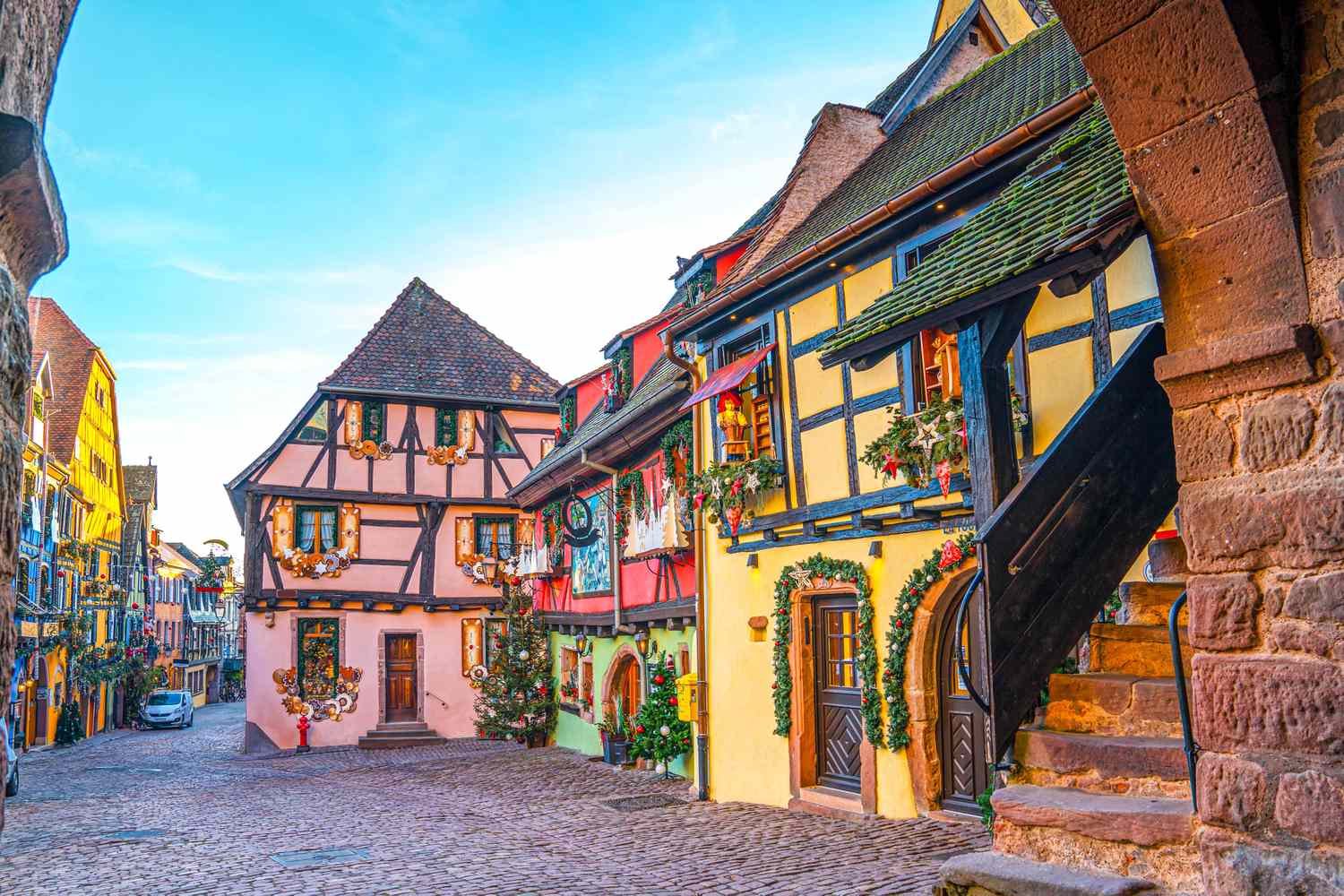
Near the German border, the east of France is all your sugarplum dreams served up on a Soufflenheim ceramic platter. The land of storks and sauerkraut is also known as “the capital of Christmas.” Alsace offers the best Christmas markets in France, hands down, with an unbeatable ambiance and setting of half-timbered houses strung with lights. The country’s oldest marché de Noël, and the grandparent of them all, is in Strasbourg. It’s here where Alsace’s German-inflected cuisine is on hearty display.
My favorite specialties are the bredle, or Christmas cookie. The varieties are as myriad as there are cookie cutter shapes — cinnamon, aniseed, almonds, oh my! — with centuries-old recipes passed down through the generations. The Bas-Rhin bakers federation sets up a pop-up bakery at the market where you can try them all and pick up recipes to make them at home. In Paris, I get my bredle fix at La Grande Épicerie, the Paris gourmet emporium with a head-spinning selection of holiday treats.
Provence
jeangill / Getty Images
While the yule log is a mainstay dessert across the Hexagon, Provence pulls out all the stops with les treize desserts. The 13 desserts represent Jesus and the 12 apostles and are laden with symbolic meaning. For example, white nougat and black nougat duel between good and evil. And then there’s the quatre mendiants (four beggars) — aka figs, raisins, almonds, and hazelnuts — which correspond to orders of medieval monks (Franciscans, Dominicans, Carmelites, and Augustinians). Other sweet treats include candied fruit, calissons d’Aix (iced, boat-shaped treats made from a paste of almonds and melon confit), and crown-shaped brioche.
That’s not to say that Provence is only beholden to tradition. These days chefs craft the most incredible, too-pretty-to-eat pastries to grace the holiday table. “In Marseille, it is not uncommon for a pâtissier to add a new dessert to their selection to compete with their neighbors… and sometimes exceed the magic number of 13!” says Emmanuel Duchange, the co-founder of the new Grand Juste hotel and a Marseille native.